
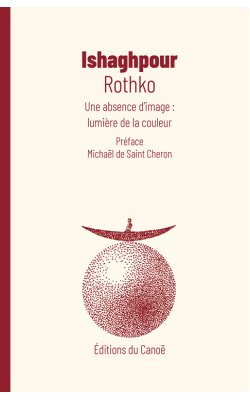
Youssef Ishaghpour
RothkoUne absence d'image : lumière de la couleurRothkoAn Absence of Image: The Light of Colour104 pages. 2023. World rights available
NON-FICTION
ESSAY
ART HISTORY
« La peinture réduite à elle-même : des couleurs sur une surface, l’absolu de la peinture et une peinture absolue. Silencieusement. Le matériau porté à l’incandescence. Le symbolique pur de toute signification, objet, image. Quelques plages de couleurs : la lumière qui en émane, irradie d’elles comme l’obscurité qui les hante, inconnue, inconnaissable. » Tels sont les premiers mots de ce bref et lumineux essai.
On comprend que cette œuvre splendide ait fasciné Ishaghpour, elle incarne l’impossible mariage entre une tradition juive intériorisée qui interdisait les images et la peinture dont l’histoire même magnifie l’image. Rothko, né Rothkowitz à Dvinsk, dans l’actuelle Lettonie, en 1903, venu à l’âge de dix ans à Portland en Oregon, n’était pas destiné à devenir peintre. Son initiation à la peinture prend la forme d’un parcours de misères. Mais ses rencontres avec Newman, Still, De Kooning, dans une Amérique en quête d’affirmation par rapport à la peinture européenne, lui permettront de réaliser sa recherche d’absolu en créant une épiphanie visible de la lumière qui n’est pas avant les couleurs mais en elles. Un essai grandiose, indispensable, qui ne cherche pas tant à lever « le voile » sur une peinture profondément tragique qu’à le rendre visible.
D’origine iranienne, vivant à Paris depuis 1958, Youssef Ishaghpour était philosophe de formation. Il s’est consacré essentiellement à la question de l’historicité de l’art et de la philosophie au XXème siècle, problème central du Poncif d’Adorno.
Il est l’auteur de plusieurs livres sur des peintres : Tàpies, Hopper, de Staël, Morandi, Rothko, Manet, Courbet, de différents essais sur le cinéma moderne et contemporain et de remarquables monographies sur des cinéastes : Visconti, Ozu, Satyajit Ray, Kiarostami, Orson Welles.
Ses livres sur la philosophie et la politique au XXème siècle (Martin Heidegger, Elias Canetti, Paul Nizan) ont été traduits en plusieurs langues.
Youssef Ishaghpour est mort brutalement le 15 octobre 2021, au moment où son essai magistral, Kiefer : la Ruine, au commencent, partait à l’impression.
“Painting reduced to itself: colors upon a surface, the absolute of painting and an absolute painting. Silently. The material brought to incandescence. The purely symbolic, stripped of all meaning, object, image. A few expanses of color: the light that emanates from them, radiating from them as does the darkness that haunts them - unknown, unknowable.” These are the opening words of this brief and luminous essay.
It is easy to understand how this splendid body of work could have fascinated Ishaghpour: it embodies the impossible union between an internalized Jewish tradition that forbade images and painting, whose very history exalts the image. Mark Rothko, born Rothkowitz in Dvinsk (in present-day Latvia) in 1903 and brought at the age of ten to Portland, Oregon, was not destined to become a painter. His initiation into painting took the form of a journey marked by hardship. Yet his encounters with Barnett Newman, Clyfford Still, and Willem de Kooning, in an America seeking to assert itself in relation to European painting, enabled him to pursue his quest for the absolute by creating a visible epiphany of light—light that does not precede colors but resides within them.
An indispensable essay, which seeks less to lift the “veil” on a profoundly tragic painting than to make that veil visible.
Of Iranian origin and living in Paris since 1958, Youssef Ishaghpour was trained as a philosopher. He devoted himself primarily to the question of the historicity of art and philosophy in the twentieth century, a central problem of Adorno’s Poncif.
He was the author of numerous books on painters - Tàpies, Hopper, de Staël, Morandi, Rothko, Manet, Courbet - as well as various essays on modern and contemporary cinema, and remarkable monographs on filmmakers such as Visconti, Ozu, Satyajit Ray, Kiarostami, and Orson Welles.
His books on twentieth-century philosophy and politics (Martin Heidegger, Elias Canetti, Paul Nizan) have been translated into several languages.
Youssef Ishaghpour died suddenly on October 15, 2021, just as his major essay, Kiefer: la Ruine, au commencement, was being sent to press.
Preface Michaël de Saint Cheron