
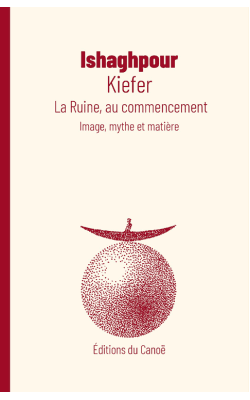
Youssef Ishaghpour
KieferLa Ruine, au commencement - Image, mythe et matièreKieferThe Ruin, at the Beginning - Image, Myth, and Matter552 pages. 2021. World rights available
NON-FICTION
ESSAY
ART HISTORY
Il fallait un esprit comme celui d’Ishaghpour, familier de la philosophie allemande comme de l’histoire de la peinture occidentale, pour réussir à donner la dimension de l’œuvre de Kiefer et décrypter les mécanismes sous-jacents à son élaboration.
Né sous les bombes, Anselm Kiefer a appris le monde en jouant dans les ruines. C’est l’origine et l’horizon de son œuvre qui s’est voulue, dès le départ, à la mesure de la grandeur auto-proclamée, auto-détruite et ravagée de l’Allemagne, et, partant de là, de celle de l’Histoire de l’humanité entière, depuis la désolation des paysages calcinés jusqu’aux décombres d’anciens temples, et même du désastre originaire inhérent à la création du monde. Héritier de l’idéalisme et du romantisme allemands, Kiefer englobe et s’approprie tout – du matériel et de l’immatériel, du cosmos et de l’univers humain : ses propres rognures d’ongles et les brins d’herbe, l’empyrée, les cailloux et les fleurs, les mythes de diverses croyances (germanique, juive, grecque, chrétienne, gnostique), la parole des poètes (Ingeborg Bachmann, Paul Celan, surtout, et beaucoup d’autres), les traces de l’Histoire, les anges, les plantes et les constellations. Utilisant des matériaux et des techniques divers, démultipliant les supports (peinture, sculpture, vitrine, livres innombrables, ateliers grandioses, véritables domaines, cosmos à part entière), Kiefer, devant le désenchantement du monde, a recours, comme Wagner avant lui, au mythe et au « grand art ». Cet essai puissant et profond interroge à travers l’œuvre de Kiefer, la possibilité de l’art dans un monde qui – après Auschwitz – a survécu à sa propre ruine.
D’origine iranienne, vivant à Paris depuis 1958, Youssef Ishaghpour était philosophe de formation. Il s’est consacré essentiellement à la question de l’historicité de l’art et de la philosophie au XXème siècle, problème central du Poncif d’Adorno.
Il est l’auteur de plusieurs livres sur des peintres : Tàpies, Hopper, de Staël, Morandi, Rothko, Manet, Courbet, de différents essais sur le cinéma moderne et contemporain et de remarquables monographies sur des cinéastes : Visconti, Ozu, Satyajit Ray, Kiarostami, Orson Welles.
Ses livres sur la philosophie et la politique au XXème siècle (Martin Heidegger, Elias Canetti, Paul Nizan) ont été traduits en plusieurs langues.
Youssef Ishaghpour est mort brutalement le 15 octobre 2021, au moment où son essai magistral, Kiefer : la Ruine, au commencent, partait à l’impression.
It took a mind like Ishaghpour’s - equally at home in German philosophy and in the history of Western painting - to succeed in conveying the full dimension of Kiefer’s work and in deciphering the underlying mechanisms of its creation.
Born amid the bombings, Anselm Kiefer learned about the world by playing in the ruins. This is both the origin and the horizon of his work, which from the outset set out to match the self-proclaimed, self-destroyed, and devastated grandeur of Germany, and, from there, that of the history of humanity as a whole - from the desolation of scorched landscapes to the debris of ancient temples, and even to the primordial disaster inherent in the creation of the world. An heir to German idealism and Romanticism, Kiefer encompasses and appropriates everything - material and immaterial alike, the cosmos and the human universe: his own nail clippings and blades of grass, the empyrean, stones and flowers, the myths of various belief systems (Germanic, Jewish, Greek, Christian, Gnostic), the words of poets (Ingeborg Bachmann, above all, Paul Celan, and many others), the traces of history, angels, plants, and constellations.
Using a wide range of materials and techniques, multiplying media and formats (painting, sculpture, display cases, countless books, monumental studios - true domains, entire cosmoses), Kiefer, in the face of the disenchantment of the world, turns - like Wagner before him - to myth and to “great art.” Through Kiefer’s work, this powerful and profound essay questions the very possibility of art in a world that - after Auschwitz - has survived its own ruin.
Of Iranian origin and living in Paris since 1958, Youssef Ishaghpour was trained as a philosopher. He devoted himself primarily to the question of the historicity of art and philosophy in the twentieth century, a central problem of Adorno’s Poncif.
He was the author of numerous books on painters - Tàpies, Hopper, de Staël, Morandi, Rothko, Manet, Courbet - as well as various essays on modern and contemporary cinema, and remarkable monographs on filmmakers such as Visconti, Ozu, Satyajit Ray, Kiarostami, and Orson Welles.
His books on twentieth-century philosophy and politics (Martin Heidegger, Elias Canetti, Paul Nizan) have been translated into several languages.
Youssef Ishaghpour died suddenly on October 15, 2021, just as his major essay, Kiefer: la Ruine, au commencement, was being sent to press.