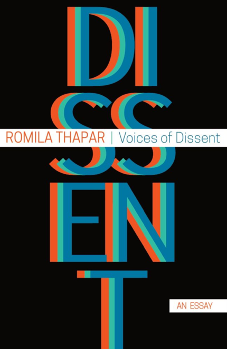
Romila Thapar
Les voix de la dissidence : un essaiVoices of Dissent: An Essay168 pages | 38 - 000 words. Original publication in 2020 - paperback edition published in 2023. Language rights sold in English (Folio Books/Pakistan) - Bengali (Pratikshan) - Hindi (Rajkamal prakashan) - Malayalam (DC Books); Marathi (Papyrus Prakashan) - Punjabi (Unistar) - Tamil (Kalachuvadu) - Japanese (Kadensha). All other language rights available
The India list
NON-FICTION
HISTORY
ESSAY
CULTURAL STUDIES
Écrit par l'une des intellectuels indiens les plus connus, ce livre est une lecture essentielle pour tous ceux qui s'intéressent à l'histoire fascinante de l'Inde et à la direction que prend le pays.
Les gens se disputent depuis des temps immémoriaux. Le désaccord fait partie de la vie, de l'expérience humaine. Mais nous vivons aujourd'hui une époque où toute forme de protestation en Inde est qualifiée d'anti-indienne et se heurte à des arguments selon lesquels le concept même de désaccord a été importé en Inde depuis l'Occident. Comme l'explique Romila Thapar dans son essai historique opportun, la dissidence a une longue histoire dans le sous-continent, même si ses formes ont évolué au fil des siècles.
Dans Voices of Dissent : An Essay, Thapar se penche sur l'articulation de la dissidence non violente et l'associe à divers moments cruciaux de l'histoire de l'Inde. En commençant par l'époque védique, elle nous emmène du deuxième au premier millénaire avant notre ère, jusqu'à l'émergence de groupes appelés conjointement les Shramanas - les Jainas, les Bouddhistes et les Ajivikas. En avançant dans le temps, elle explore également les points de vue des Bhakti sants et d'autres groupes des quinzième et seizième siècles et nous amène à un moment majeur de dissidence qui a contribué à l'établissement d'une Inde libre et démocratique : Le satyagraha du Mahatma Gandhi. Thapar replace ensuite dans leur contexte les récentes manifestations pacifiques contre la nouvelle loi controversée sur la citoyenneté en Inde, en soutenant qu'à notre époque, la dissidence doit s'opposer à l'injustice et soutenir les droits démocratiques afin que la société puisse changer pour le mieux.
Romila Thapar est professeur émérite d'histoire à l'université Jawaharlal Nehru, à New Delhi, et a été présidente générale de l'Indian History Congress. Elle est membre de la British Academy et titulaire de doctorats honorifiques des universités de Calcutta, d'Oxford et de Chicago, entre autres. Elle est membre honoraire de Lady Margaret Hall, Oxford, et de SOAS, Londres. En 2008, elle a reçu le prestigieux prix Kluge de la Bibliothèque du Congrès.
Written by one of India’s best-known public intellectuals, this book is essential reading for anyone interested in India’s fascinating history as well as the direction in which the nation is headed.
People have argued since time immemorial. Disagreement is a part of life, of human experience. But we now live in times when any form of protest in India is marked as anti-Indian and met with arguments that the very concept of dissent was imported into India from the West. As Romila Thapar explores in her timely historical essay, however, dissent has a long history in the subcontinent, even if its forms have evolved through the centuries.
In Voices of Dissent: An Essay, Thapar looks at the articulation of nonviolent dissent and relates it to various pivotal moments throughout India’s history. Beginning with Vedic times, she takes us from the second to the first millennium BCE, to the emergence of groups that were jointly called the Shramanas—the Jainas, Buddhists, and Ajivikas. Going forward in time, she also explores the views of the Bhakti sants and others of the fifteenth and sixteenth centuries and brings us to a major moment of dissent that helped to establish a free and democratic India: Mahatma Gandhi’s satyagraha. Then Thapar places in context the recent peaceful protests against India’s new, controversial citizenship law, maintaining that dissent in our time must be opposed to injustice and supportive of democratic rights so that society may change for the better.
Romila Thapar is an emeritus professor of history at the Jawaharlal Nehru University, New Delhi, and she was previously the general president of the Indian History Congress. She is a fellow of the British Academy and holds honorary doctorates from the Universities of Calcutta, Oxford, and Chicago, among others. She is an Honorary Fellow of Lady Margaret Hall, Oxford, and SOAS, London. In 2008, she was awarded the prestigious Kluge Prize from the Library of Congress.
‘Where this book shines is in its discussion of how dissent often arises from within cultures, and not from outside, restructuring social relations and enabling mutation of knowledge through the questioning of institutions’—Business Standard
‘Dissent, expressed against the state as much as institutional forms of religion, creates traditions of thinking that are always available as a resource. Hence, when Gandhi thinking against colonial violence thinks through the idea of satyagraha, he draws upon a library of dissent with its vocabulary and forms… Thapar does not make an argument for passive inheritance. At each historical juncture, the reimagining of an ethical conception of equality and compassion draws upon a rich vein of dissentient thought. Democracy survives because of dissent. Forms of political and social orthodoxy are contingent; and the battle against them is always ongoing.’—India Today