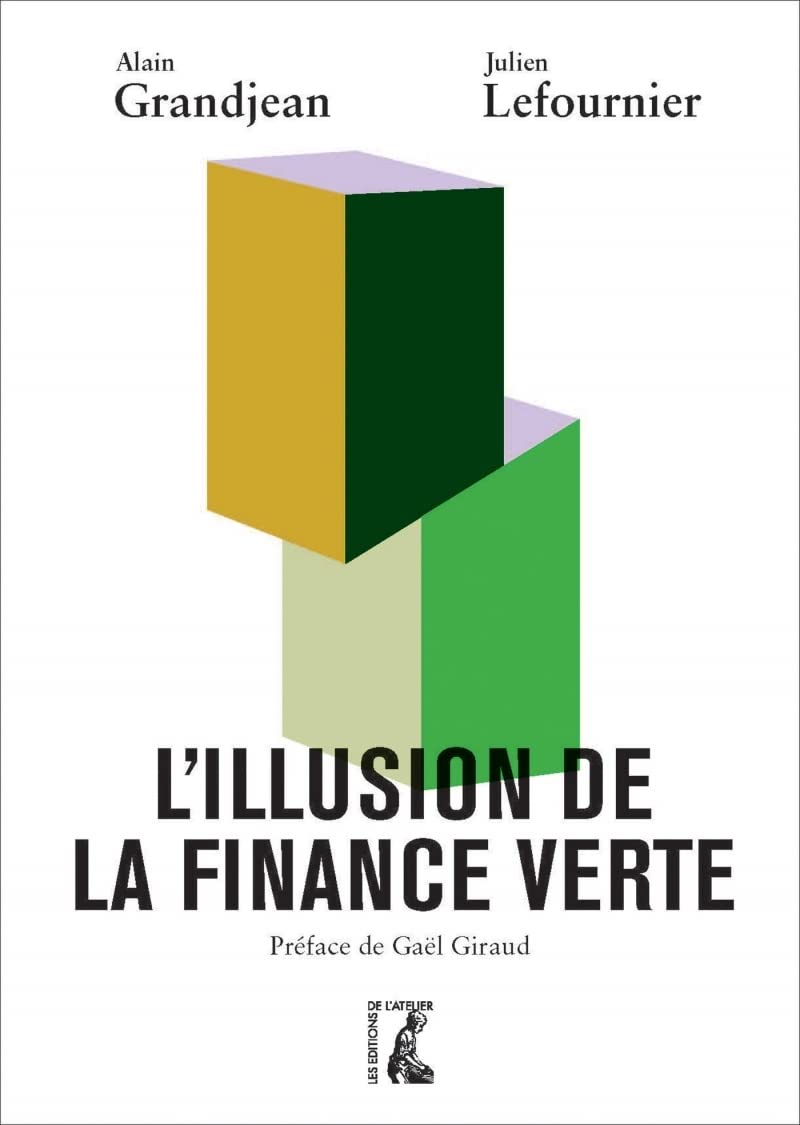
Alain Grandjean
Julien Lefournier
L'illusion de la finance verteThe Illusion of green Finance248 pages. 2021. World rights available
NON-FICTION
ECONOMY
POLITICS
La finance peut-elle sauver le climat ? La prolifération d’actifs “responsables” censés favoriser la transition énergétique laisse penser qu’il est possible de “donner un sens à son argent”. Ce livre analyse en profondeur ce phénomène en pleine croissance afin de déconstruire, de manière pédagogique et implacable, un storytelling généralisé. Un Français sur deux souhaiterait que son épargne profite à l’écologie. Depuis une quinzaine d'années, émergent de nouveaux produits "eco responsables", logos tout verts et slogans prometteurs. Mais qu’en est-il réellement ?
Si l’argent servait la planète, cela supposerait que les acteurs de la finance acceptent de réduire le rendement de leurs investissements, un peu selon le principe du commerce équitable : le consommateur paye sciemment un produit plus cher pour qu’une partie de son argent revienne au producteur ou participe à la préservation de l’environnement.
Mais les placements verts sont tout aussi rentables que les autres. La raison d’être de la finance verte demeure inchangée : optimiser son retour sur investissement.
“Obligations vertes, “green bonds” etc... Ces titres mirifiques que l’on voit fleurir depuis quelques années ne sont donc qu'artifices marketing visant à duper le consommateur concerné. Une véritable propagande que ce livre met en lumière, pour la première fois.
Alain Grandjean est le président de la fondation Nicolas Hulot et membre du Haut conseil pour le climat. Il est aussi cofondateur et associé à Carbone 4, cabinet de conseil en stratégie climat et i l’auteur d’Une monnaie écologique (Odile Jacob, 2020) et aux éditions de l’Atelier, de Financer la transition énergétique avec Mireille Martini en 2016.
Julien Lefournier a travaillé pendant 25 ans sur les marchés financiers. Il a quitté l’industrie bancaire et intervient depuis dans différents groupes de travail pour sensibiliser aux limites de la finance verte telle qu’elle se développe.
Gaël Giraud était chef économiste de l’AFD. Prêtre jésuite, professeur d’économie à Georgetown à Washington. Il est l’auteur d’Illusion financière (+ 25.000 exemplaires vendus).
Can finance save the climate? The proliferation of 'responsible' assets that are supposed to promote the energy transition suggests that it is possible to 'make sense of your money'. This book takes an in-depth look at this fast-growing phenomenon, deconstructing the widespread storytelling in a way that is both educational and uncompromising. One in two French people would like their savings to benefit the environment. It's an expression of interest that seems to be particularly appealing to those in the financial sector. Over the last fifteen years or so, new "eco-responsible" products have become increasingly popular, with green logos and promising slogans. But what is the reality?
If money served the planet, this would presuppose that financial players agreed to reduce the return on their investments, rather like the principle of fair trade: consumers knowingly pay more for a product so that part of their money goes back to the producer or helps to preserve the environment.
But green investments are just as profitable as others. The raison d'être of green finance remains unchanged: maximizing return on investment, despite the misleading packaging.
"Green bonds etc... The glittering titles that have been springing up in recent years are nothing more than marketing gimmicks designed to dupe the consumer. This book sheds light on this propaganda for the first time.
Alain Grandjean is Chairman of the Nicolas Hulot Foundation and a member of the High Council for the Climate. He is also co-founder and partner of Carbone 4, a climate strategy consultancy, and is the author of Une monnaie écologique (Odile Jacob, 2020) and, published by Editions de l'Atelier, of Financer la transition énergétique with Mireille Martini in 2016.
Julien Lefournier, worked in the financial markets for 25 years. He left the banking industry and has since been involved in various working groups to raise awareness of the limits of green finance as it is developing.
Gaël Giraud was chief economist at the French Development Agency. He is a Jesuit priest and professor of economics at Georgetown University in Washington. He is the author of Illusion financière (over 25,000 copies sold).
Preface by Gaël Giraud