Frédéric Neyrat
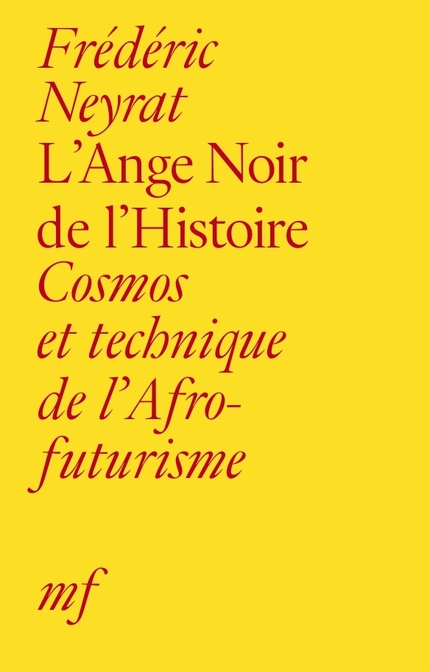
L'ange noir de l'Histoire: cosmos et technique de l'Afro-futurismeThe black Angel of History: Cosmos and Technique of Afro-futurism130 pages. 2021. Sold in Italian (Efesto) and German (Merve). All other language publication rights available
Inventions (MF)
PHILOSOPHY
ESSAY
AFROFUTURISM
En analysant la musique, la littérature et la peinture afrofuturistes (Sun Ra, P-Funk, Wangechi Mutu), en les confrontant aux questions contemporaines d’écologie et de racialisation, ce livre montre comment l’afrofuturisme peut nous guérir de l’anthropocène. L’afrofuturisme propose une nouvelle image du cosmos, dans laquelle la Terre est liée au pouvoir du soleil et aux ténèbres insondables de l’univers. Cette nouvelle relation avec le cosmos exige que nous changions la fonction de la technologie, qui n’est considérée que comme une source de possibilités — être capable de maîtriser les forces terrestres, de contrôler les êtres humains et d’exploiter les non-humains.
A ces possibilités écologiquement et socialement épuisantes, l’Afrofuturisme oppose un impossible majeur, une utopie para-humaine, extraterrestre, où la technologie devient une technique de l’imaginaire, jouant le rôle de médiation esthétique entre la Terre et les autres planètes, le passé et le futur, les êtres humains et ce qui leur reste étranger.
Montrant les affinités entre la pensée à l’œuvre dans l’afrofuturisme et la philosophie de Walter Benjamin, comparant l’afrofuturisme à la théorie radicale de l’afropessi-mism et à l’utopie du cosmisme russe, ce livre vise à diffuser le message de l’Ange noir de l’Histoire : si nous voulons éviter l’effondrement écologique auquel l’économie racialisée nous destine, nous avons besoin d’une nouvelle révolution copernicienne.
https://www.editions-mf.com/articles/38/l-ange-noir-de-l-histoire-dans-le-journal-le-monde-un-article-signe-david-zerbib
Frédéric Neyrat est philosophe et professeur associé au Département d’anglais de l’Université du Wisconsin-Madison (USA), où il est également titulaire d’une chaire en "humanités planétaires".
Il héberge la plateforme électronique Alienocene et a récemment publié Literature and Materialisms (Routledge, 2020), Échapper à l’horreur : Traité des interruptions merveilleuses (Lignes, 2017) et La Part inconstructible de la Terre : Critique du géo-constructivisme (2016). https://atoposophie.wordpress.com
Analyzing Afrofuturist music, literature and painting (Sun Ra, P-Funk, Wangechi Mutu), confronting them with contemporary issues of ecology and racialization, this book shows how Afrofuturism can heal us from the Anthropocene. Afrofuturism proposes a new image of the cosmos, in which the Earth is linked to the power of the sun and the unfathomable darkness of the universe. This new relationship to the cosmos requires us to change the function of technology, which is seen only as a source of possibilities—to be able to master earth forces, to be able to control human beings, and to be able to exploit non-humans.
To these ecologically and socially exhausting possibilities, Afrofuturism opposes a major impossible, a para-human, alien utopia, where technology becomes a technique of the imaginary, playing the role of aesthetic mediation between Earth and other planets, past and future, human beings and what remains alien to them.
Showing the affinities between the thinking at work in Afrofuturism and the philosophy of Walter Benjamin, com- paring Afrofuturism with the radical theory of Afropessi-mism and the utopia of Russian cosmism, this book aims to help spread the message of the Black Angel of History: if we are to avoid the ecological collapse to which the racialized economy is destining us, we need a new Copernican revolution.
Frédéric Neyrat is a philosopher and associate professor in the Department of English at the University of Wisconsin-Madison (USA), where he also holds a chair in "planetary humanities".
He hosts the electronic platform Alienocene and has recently published Literature and Materialisms (Routledge, 2020), Échapper à l’horreur : Traité des interruptions merveilleuses (Lignes, 2017) and La Part inconstructible de la Terre : Critique du géo-constructivisme (2016). https://atoposophie.wordpress.com