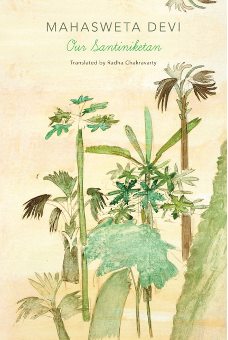
Mahasweta Devi
Notre SantiniketanOur Santiniketan120 pages | 29 - 000 words. Originally published in Bengali as Amader Santiniketan (Krishi Prakashan - 2001). Published in English translation in 2022. All other language rights available
The India list
NON-FICTION
NARRATIVE NON FICTION
MEMOIR / TESTIMONY
Comme une plume éblouissante tombée d'on ne sait où... Combien de temps la plume gardera-t-elle ses couleurs, dans l'attente ? La "plume" représente les souvenirs d'enfance. Les souvenirs n'attendent pas.
Dans Our Sanitikentan, la regrettée Mahasweta Devi, l'un des écrivains les plus célèbres de l'Inde, raconte de manière très vivante son enfance dans les années 1930, lorsqu'elle était écolière. Alors que l'auteure vieillissante s'efforce de retrouver des vignettes de son enfance, ces réminiscences transposent sur la page écrite non seulement sa sensibilité individuelle, mais aussi tout un ethos.
Santiniketan abrite l'école et l'université fondées par la plus grande icône littéraire et culturelle de l'Inde, Rabindranath Tagore. Dans ces pages, un Santiniketan oublié, vu à travers les yeux innocents d'une jeune fille, prend vie - le lieu, ses habitants, sa flore et sa faune, ainsi que son environnement éducatif, sa culture de libre expression créative, sa vision d'une coexistence harmonieuse entre les mondes naturel et humain, et l'imposante présence de Tagore lui-même. Parallèlement, nous avons un aperçu de la vie privée de Mahasweta, de sa vie intérieure, de sa famille et de ses associés, ainsi que des premières expériences qui ont façonné sa personnalité.
Voyage nostalgique dans une époque révolue, rappelant ses valeurs simples et profondes - si lointaines aujourd'hui et si urgentes à nouveau - Our Santinketan est un ajout inestimable à l'œuvre de Devi
Mahasweta Devi (1926-2016) a été l’une des figures littéraires les plus en vue de l’Inde de la fin du XXe siècle et du début du XXIe siècle, écrivaine et militante sociale de plein droit. Auteur de nombreux romans, essais et nouvelles, elle a reçu le prix Jnanpith, la plus haute distinction littéraire de l’Inde, en 1996. Elle a reçu le prix Ramon Magsaysay en 1997 pour sa « croisade compatissante par l’art et l’activisme pour réclamer aux peuples tribaux une place juste et honorable dans la vie nationale indienne ».
Like a dazzling feather that has fluttered down from some unknown place… How long will the feather keep its colours, waiting? The ‘feather’ stands for memories of childhood. Memories don’t wait.
In Our Sanitikentan, the late Mahasweta Devi, one of India’s most celebrated writers, vividly narrates her days as a schoolgirl in the 1930s. As the aging author struggles to recapture vignettes of her childhood, these reminiscences bring to the written page not only her individual sensibility but an entire ethos.
Santiniketan is home to the school and university founded by the foremost literary and cultural icon of India, Rabindranath Tagore. In these pages, a forgotten Santiniketan, seen through the innocent eyes of a young girl, comes to life—the place, its people, flora and fauna, along with its educational environment, culture of free creative expression, vision of harmonious coexistence between natural and human worlds, and the towering presence of Tagore himself. Alongside, we get a glimpse of the private Mahasweta—her inner life, family and associates, and the early experiences that shaped her personality.
A nostalgic journey to a bygone era, harking back to its simple yet profound values—so distant today and so urgent yet again—Our Santiniketan is an invaluable addition to Devi’s rich oeuvre available in English translation.
Mahasweta Devi (1926–2016) was one of India’s foremost literary figures from the late twentieth and early twenty-first centuries—a writer and social activist in equal right. Author of numerous novels, essays and short stories, she received the Jnanpith Award, India’s highest literary honour, in 1996. She was awarded the Ramon Magsaysay Award in 1997 for her ‘compassionate crusade through art and activism to claim for tribal peoples a just and honourable place in India's national life’.
‘Reading this memoir has been like an idyllic escape into a Rousseauvian world where one is transported to an existence beyond mundane, manmade borders. That Santiniketan and Sriniketan were both projects shattering the confines of “narrow domestic walls” is evident with the involvement of thinkers, scientists, writers and ideators from all over the world. The translation of the memoir has actually captured that surge of energy that could help us move towards a better, more humanitarian world. This is an intense, immersive, inspiring, and refreshing read.’—The Daily Star