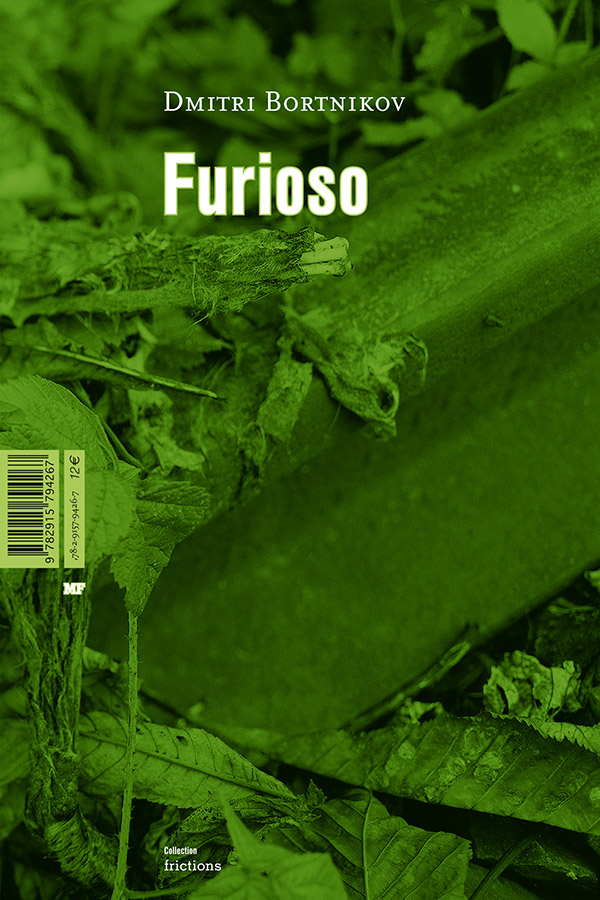
Dmitri Bortnikov
FuriosoFurioso120 pages. 2015. World rights available
Inventions (MF)
FICTION
LITTERATURE
Furioso évoque divers moments cruciaux dans la vie d’une jeune femme nommée Dagmar. Suite de la perte d’un enfant à la naissance, elle sombre dans la folie. Le texte met en lumière cette folie qui était déjà au cœur de l’existence de cette femme. Furioso est construit à partir de scènes accolées, comme des flashs de mémoire, comme des morceaux de dialogue intérieur dont se dégage une forme de méta-narration.
Ce poème est l’aboutissement d’un travail sur la langue. C’est la création d’un univers poétique abolissant les rapports de cause à effet. Ici le langage est en perpétuelle invention et se fixe pour but d’empêcher le discours de naître. Ainsi, l’auteur colonise, voire parasite la langue française, déstabilisant le lecteur/locuteur français par un langage affranchi du lieu commun.
L’aspect singulier de ce texte réside également dans le fait que l’auteur a déjà publié trois romans en langue russe, salués par la critique. Dmitri Bortnikov a pris la langue française à bras-le-corps pour écrire un texte poétique totalement débridé. Un texte « francophone » hors norme qui n’a rien à régler avec la langue française. L’auteur n’a pas à se positionner vis à vis d’elle.
Dmitri Bortnikov est né à Samara en 1968. Il a entamé des études de médecine qu’il a dû arrêter pour faire son service militaire. Il a été tour à tour cuisinier, aide-soignant, professeur de danse.
Il est l’auteur de trois livres. Son premier roman Le syndrome de Fritz (Limbus Press, Saint Pétersbourg) a obtenu le Booker Prize russe en 2002 ainsi que le prix National best-seller la même année. Son dernier roman, Face au Styx (éditions Rivages, 2017). Il vit en France depuis 1999. Furioso est son premier texte écrit en français.
Furioso evokes various crucial moments in the life of a young woman named Dagmar. Following the loss of a child at birth, she plunges into madness. The text highlights this madness that was already at the heart of this woman’s existence. Furioso is constructed from adjacent scenes, like flashes of memory, like pieces of inner dialogue from which emerges a form of meta-narration.
This poem is the culmination of a work on language. It is the creation of a poetic universe abolishing the relationship of cause and effect. Here language is in perpetual invention and sets itself the goal of preventing speech from being born. Thus, the author colonizes or even parasitizes the French language, destabilizing the French reader/ speaker by a language freed from the common place.
The singular aspect of this text also lies in the fact that the author has already published three novels in the Russian language, acclaimed by critics. Dmitri Bortnikov took the French language by arm-in-arm to write a completely unbridled poetic text. An extraordinary “francophone” text that has nothing to do with the French language. The author does not have to stand up to it.
Dmitri Bortnikov was born in Samara in 1968. He began medical studies that he had to stop for military service. He was in turn a cook, a nursing assistant, a dance teacher. He is the author of three books. His first novel Fritz’s Syndrome (Limbus Press, Saint Petersburg) won the Russian Booker Prize in 2002 and the National Best Seller Award in the same year. His latest novel, Face au Styx, was published in 2017 by Rivages. He has lived in France since 1999. Furioso is his first text written in French.