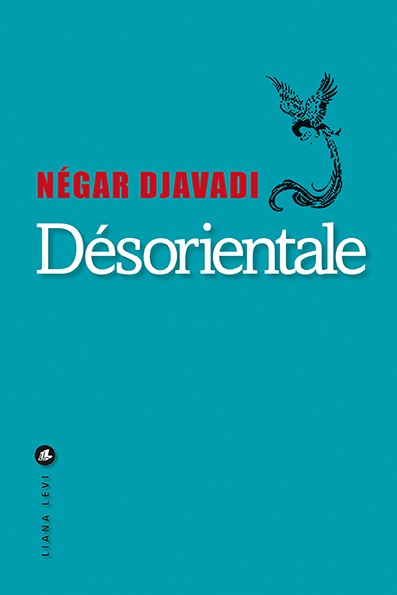
Négar Djavadi
DésorientaleDisoriental352 pages. 2016. In negotiation in Portuguese (Brazil). Sold in Italian (E/O) ; English (Europa, WEL) ; German (Beck) ; Spanish (Malpaso) ; Romanian (Polirom); Slovenian (Založba cf.) ; Croatian (Meandra media) ; Latvian (Janis Roze); Hebrew (Xargol); Serbian (JP Službeni) ; Slovak (Inaque) ; Lithuanian (Baltos Lankos);Turkish (New Human) ; Polish (Czarne)
FICTION
Prix Prem1ère (RTBF)
Prix du style Prix Albertine 2019
Prix Emmanuel Roblès du premier roman à Blois
Prix des librairies Folies d’encre
Meilleur premier roman français LIRE
Prix de la librairie L’Autre Monde à Avallon
Prix Terres de parole
Prix de la librairie Delamain à Paris
Prix des lecteurs des Pays du Gois
Prix de la médiathèque de Saint-Renan
Prix du premier roman des médiathèques de Colombes
Prix de la librairie Lilly à Honfleur
Prix de la Porte dorée
Prix des lecteurs de la librairie La Galerne au Havre
Prix Cinélect Dorothée Théron bibliothèque de Joinville le Pont
Prix des Lecteurs de Cenon
Prix du Cercle de Lecture AVF Manosque
Prix Roman News
Tenir à distance sa culture, son pays natal, sa famille... c’est ainsi que Kimiâ Sadr vit l’exil. Elle a fui l’Iran à dix ans avec sa mère et ses sœurs
pour rejoindre la France et son père. Pourtant, malgré elle, lors des heures passées à l’hôpital Cochin où elle attend l’issue d’un long protocole d’insémination artificielle, la jeune femme est rattrapée
par ses souvenirs. Et par tous ceux qui en furent les acteurs. Dans un monologue joyeusement désordonné, Kimîa déroule toute l’histoire de la famille Sadr. On y croise trois générations d’ancêtres flamboyants: l’arrière-grand-père, le redoutable Montazemolmolk, régnant sur un harem de cinquante-deux épouses dans une province reculée de Perse; Nour, la fille préférée du Khan car elle possède les mêmes yeux bleus que lui; Darius, Le Téméraire, Le Tumultueux, le père de Kimiâ, éternel opposant aux régimes en place – celui du Shah, puis de Khomeiny; Sara, sa mère, d’origine arménienne, à la fois pasionaria et gardienne de la tradition; et aussi des oncles numérotés de 1 à 6 dont le Numéro 2, dépositaire de la mémoire familiale... Défilent aussi dans ce captivant diaporama les moments-clés de la vie politique iranienne des années 60 et 70. Pour s’éloigner de cet encombrant héritage (sur lequel plane
la menace d’un Événement qu’elle a du mal à raconter) et découvrir qui elle est vraiment, Kimiâ rasera ses cheveux façon punk, quittera Paris pour Berlin, Londres ou Bruxelles, s’étourdira de rock and roll... jusqu’à accepter le chemin inattendu pris par sa vie amoureuse, son homosexualité et sa désorientalisation...
Un peu de Virginie Despentes et de Shéhérazade se mêlent chez Kimiâ,
l’héroïne de Négar Djavadi. Pour son premier roman, celle-ci emprunte
aussi bien aux contes d’Orient qu’aux techniques cinématographiques pour faire se télescoper des temporalités et des lieux différents. Une fresque impétueuse, émouvante, passionnante.
Négar Djavadi naît en Iran en 1969 dans une famille d’intellectuels opposants au Shah puis à Khomeiny. Elle a onze ans lorsqu’elle arrive clandestinement en France. Diplômée de l’INSAS, une école de cinéma bruxelloise, elle travaille plusieurs années derrière la caméra avant de se consacrer à l’écriture de scénarios. En 2016, Désorientale, son premier roman est un succès de librairie unanimement salué, traduit en une dizaine de langues. Son deuxième roman, Arène, paru en août 2020, a été salué par la critique et les libraires (Prix Millepages 2020). Les droits audiovisuels ont été cédés.
By night, Kimiâ mixes alternative rock at concerts. By day, she fol- lows a treatment of artificial insemination to have a child with her girlfriend Anna. Born in Tehran in 1971, exiled in France ten years later, to live free, she’s always kept her distance from her native culture. But in the waiting room of the MAP unit at the hospital, from one medical appointment to another, the genies escaped from the past catch up with her. Over the course of intertwined memo- ries, in a long aside to the reader, she unfolds the whole story of the Sadr family. From her petulant ancestors from nothern Persia down to her own parents, Darius and Sara, eternal opponents of the regime of the day: that of the Shah, until 1979, then that of Khomeiny.This last episode was to force their definitive flight from Iran. Unfortunately, the France lived in exile is nothing like the land mythologised by the Iranian bourgeoisie... Then, playing on flash- backs and fast-forwards, Kimiâ convokes three generations and a goddess of rock and roll to the bedside of her «disorientalisation.»
Négar Djavadi is a novelist and screenwriter. Born in Teheran in 1969, she grew up in Paris. Following cinema studies in Brussels, she started out behind the camera as an assistant operator. Her first award-winning screenplay decided her to devote herself to writing. TV films and series followed one after the other. In 2016, she published her first novel, Disoriental, to real success (130,000 copies), translated in a dozen languages, Albertine Prize and Lambda Literary Award 2019 and on the Dublin Literary Award’s shortlist 2020.
“Désorientale reads in one breath, a beautiful anthem to the freedom to live, to think, to love.” — L’Humeur vagabonde, France Inter
“Emotion, comedy, fever and drama.” — Elle
“An enchanting pen.” — Canal+
“Outstanding. One of the strongest novels of the season.” — La Grande Librairie, France 5
“It’s rare to encounter such a powerful first novel.” — Grazia
“A voice that delights us as much as it grips us.” — Le Monde des livres
“A masterstroke.” — Psychologies magazine
“A novelistic epic.” — Le Figaro littéraire
“An odyssey.” — L’Humanité
“An autobiography full of liberating fictions.” — Lire
“A breathless monologue where a family saga meets an intimate narrative.” — Livres Hebdo
“A devilishly romantic story, full of deliciously oriental digressions.” — Télérama
“A coming-of-age novel à la iranienne.” — Libération
“Fueled by a politically incorrect, resolutely spontaneous streak, the novel is a celebration of life and music.” — Le Matricule des anges
“A paradoxical, brilliantly audacious saga: one of the finest surprises of late summer.” — Diacritik
“Epic and magnificent.” — La Nouvelle République
“A sharp, modern tale.” — Onlalu
“To read and reread, an inexhaustible novel.” — Le 1
“The singular trajectory of a young woman confronting the turmoil of identity.” — La Libre Belgique
“Between social satire and Persian tale, this novel plunges us into the history of Iran and the story of a woman in search of herself.” — Biba
“A fast-paced and humorous debut novel.” — Ouest France