Salim Barakat
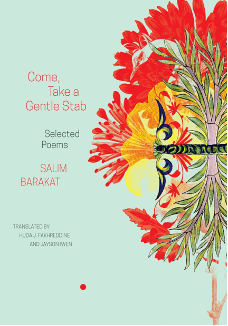
Come, Take a Gentle StabCome, Take a Gentle Stab132 pages | 11 - 750 words (including foreword). Published in English translation in 2022. All language rights available except English and Arabic.
The Arab List
POETRY
SHORTLISTED FOR THE SARAH MAGUIRE PRIZE 2022
Ce premier recueil de poèmes de Salim Barakat en anglais, représentant toutes les étapes de sa carrière, remédie à cette surprenante omission. Come, Take a Gentle Stab présente une sélection de ses œuvres poétiques les plus acclamées.
Kurde syrien, Barakat a choisi d'écrire en arabe, la langue de l'hégémonie culturelle et politique qui a marginalisé son peuple. Comme Paul Celan, il a maîtrisé la langue de l'oppresseur à tel point que le cours de la langue elle-même a été contraint de se plier à sa volonté. Barakat pousse l'arabe juste au-delà de ses limites linguistiques, en les étirant. Il résiste à la cohérence, mais ne la détruit jamais, se retirant avant le coup final. Il en résulte une abstraction figurative de la lutte, aussi vivante que la lutte elle-même. Et toujours sous la surface de cette eau bouillonnante, on peut apercevoir les courants profonds de l'ancienne culture kurde.
Salim Barakat est un poète et romancier kurdo-syrien.Il est né en 1951 à Qamishli, une ville du nord de la Syrie qui se caractérise par sa diversité ethnique, religieuse et linguistique. Il s'est installé à Damas au début des années 1970, puis à Beyrouth.En 1982, l'escalade des tensions politiques et sectaires dans cette ville déchirée par la guerre l'a contraint à partir pour Chypre, où il est resté plus de quinze ans. Il réside à Stockholm, en Suède, depuis 1999. Il a publié plus de quarante-six ouvrages de poésie et de prose, dont trois autobiographies. Il a été proposé pour le prix Nobel de littérature en 2022.
This first collection of Salim Barakat’s poetry in English, representing every stage of his career, remedies that startling omission. Come, Take a Gentle Stab features selections from his most acclaimed works of poetry.
A Kurdish-Syrian man, Barakat chose to write in Arabic, the language of cultural and political hegemony that has marginalized his people. Like Paul Celan, he mastered the language of the oppressor to such an extent that the course of the language itself has been compelled to bend to his will. Barakat pushes Arabic to a point just beyond its linguistic limits, stretching those limits. He resists coherence, but never destroys it, pulling back before the final blow. What results is a figurative abstraction of struggle, as alive as the struggle itself. And always beneath the surface of this roiling water one can glimpse the deep currents of ancient Kurdish culture.
Salim Barakat is a Kurdish-Syrian poet and novelist. He was born in 1951 in Qamishli, an ethnically, religiously, and linguistically diverse city in northern Syria. He moved to Damascus in the early 1970s and then on to Beirut. In 1982 the escalating political and sectarian tensions in the war-torn city forced him to leave for Cyprus, where he remained over fifteen years. He has been residing in Stockholm, Sweden, since 1999. He has published over forty-six works of poetry and prose, including three autobiographies. He was nominated for the Nobel Prize in Literature in 2022.
Originally written in Arabic
Translated into English by Huda J. Fakhreddine and Jayson Iwen
PDF of English translation available
‘Unsettling, enigmatic, singular. The poetry of the Kurdish-Syrian master Salim Barakat keeps us suspended. Come, Take a Gentle Stab penetrates places we didn’t know were reachable. An arresting collection.’—Nathalie Handal
‘What is there to say about these poems that largely escape sense and make so much happen? They take refuge in a long history of song . . . and summon us to join them. This translation is most alluring where it gives form to Barakat’s philosophy, a poetics of damage that is always available to the consolations of sonic relief.’—4Columns