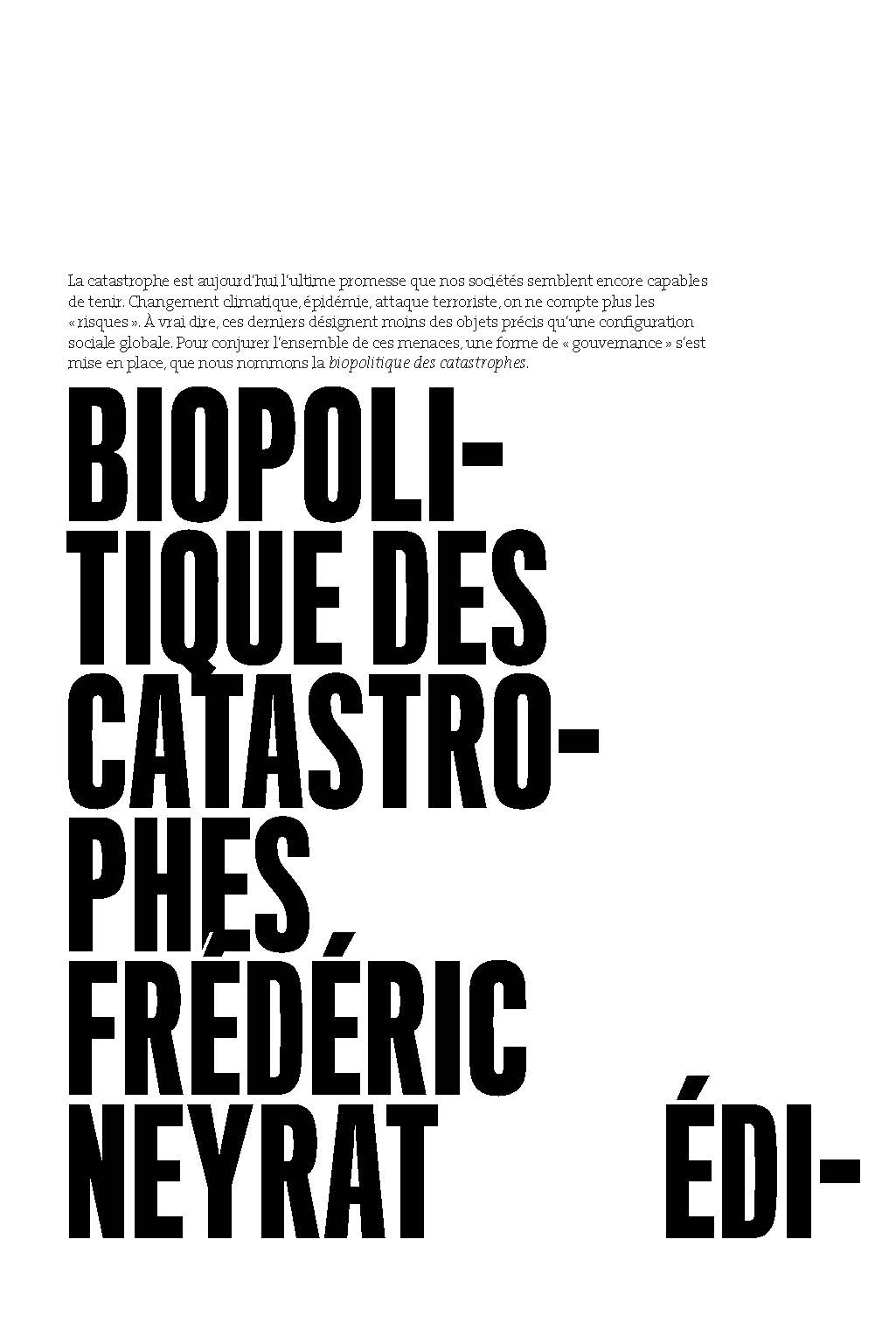
Frédéric Neyrat
Biopolitique des catastrophesBiopolitics of Disasters172 pages. 2008. World rights available
Inventions (MF)
PHILOSOPHY
POLITICS
ESSAY
La catastrophe est aujourd’hui l’ultime promesse que nos sociétés semblent encore capables de tenir. Changement climatique, épidémie, attaque terroriste, on ne compte plus les « risques » et les « menaces ». L’objectif premier de ce livre est d’analyser les transformations sociales, politiques et ontologiques qui ont pu façonner un tel sentiment : les « risques » désignent moins des objets précis qu’une configuration sociale globale. Pour conjurer l’ensemble de ces menaces, une nouvelle forme de « gouvernance » s’est aujourd’hui mise en place, que nous nommons la biopolitique des catastrophes. Elle se développe sous la forme d’une immuno-politique, qui tend à vouloir se protéger de toute atteinte, de toute altérité comme de toute altération. Et, pour le coup, de toute possibilité de changement politique. Plus grave encore : en voulant protéger, elle détruit. Elle alimente, renforce les dangers qu’elle est censée combattre. Et se révèle finalement pour ce qu’elle est, une thanato-politique. Comment sortir de ce piège ? Plus l’homme cherche à s’excepter du monde et du vivant, plus il détruit le monde, plus il accumule les dommages.
Pour sortir du piège immuno-politique, une seule solution : y renter résolument. Ce qui veut dire passer du statut d’exception à celui d’être en relations, ce qui veut dire être vraiment dans le monde.
Frédéric Neyrat est philosophe et professeur associé au Département d’anglais de l’Université du Wisconsin-Madison (USA), où il est également titulaire d’une chaire en "humanités planétaires".
Il héberge la plateforme électronique Alienocene et a récemment publié Literature and Materialisms (Routledge, 2020), Échapper à l’horreur : Traité des interruptions merveilleuses (Lignes, 2017) et La Part inconstructible de la Terre : Critique du géo-constructivisme (2016). https://atoposophie.wordpress.com
Disaster is now the ultimate promise that our societies still seem capable of keeping. Climate change, epidemics, terrorist attacks, there are countless «risks» and «threats». The primary objective of this book is to analyze the social, political and ontological transformations that have shaped such a feeling: «risks» refer less to precise objects than to a global social configuration. To ward off all these threats, a new form of «governance» has now been put in place, which we call the biopolitics of disasters. It develops in the form of an immuno-political, which tends to protect itself from any damage, any alterity as well as any alteration. And at the same time, of any possibility of political change. More serious: in wanting to protect, it destroys. It fuels, reinforces the dangers it is supposed to fight. And finally reveals itself for what it is, a thanato-political. How to get out of this trap? By analyzing the different techniques of this bio-politics and this immuno-politics, by going to flush out the unconscious fantasy that works in depth, that of an absolute indemnity, of a total immunity. Here is the strange hypothesis that this book formulates: the more we believe ourselves immortal, the more we self-destruct. The more man seeks to be apart from the world and the living, the more he destroys the world, the more he accumulates damage.
To get out of the immuno-political trap, there is only one solution: to return resolutely. Which means going from the status of exception to that of being in relationships, which means really being in the world.
Frédéric Neyrat is a philosopher and associate professor in the Department of English at the University of Wisconsin-Madison (USA), where he also holds a chair in "planetary humanities".
He hosts the electronic platform Alienocene and has recently published Literature and Materialisms (Routledge, 2020), Échapper à l’horreur : Traité des interruptions merveilleuses (Lignes, 2017) and La Part inconstructible de la Terre : Critique du géo-constructivisme (2016). https://atoposophie.wordpress.com