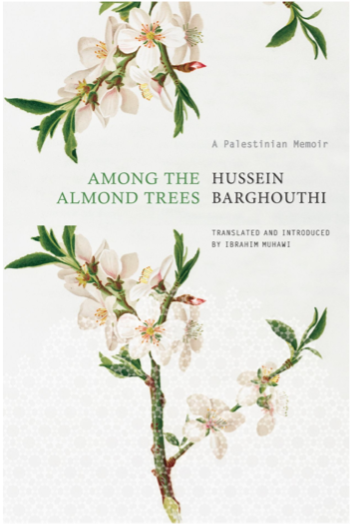
Hussein Barghouthi
Parmi les amandiers - mémoires de PalestineAmong the Almond Trees - A Palestinian Memoir154 pages | 31000 words. First published in Arabic as Saʾakūnu bayn al-Lawz. Published in English translation in 2022. Sold in French (Actes Sud). All other language rights available -
The Arab List
NON-FICTION
MEMOIR / TESTIMONY
Winner of Palestine Book Award 2023
Des mémoires poétiques et d'une douceur amère sur la nature, la mort, la vie en Palestine et le concept universel de foyer.
L'écrivain palestinien Hussein Barghouthi avait une quarantaine d'années lorsqu'on lui a diagnostiqué un lymphome. Il avait craint qu'il s'agisse du VIH et, lorsque le diagnostic a été confirmé, il a quitté l'hôpital en éprouvant une joie amère parce que sa femme et son fils seraient épargnés. La douceur amère de cette réaction caractérise l'alternance de narration et de réflexion qui caractérise ces mémoire méditatives.
Pour faire face à la finalité, Barghouthi revient à ses souvenirs d'enfance dans son village natal du centre de la Palestine, où la maison dans laquelle il a grandi est entourée de vergers d'amandiers et de figuiers. Il fait de nombreuses promenades curatives à l'ombre des arbres, au clair de lune, où il observe des renards curieux, des gazelles dansantes, un blaireau au cri étrange, une belette et un sanglier avec ses petits - un retour non seulement à la maison, mais aussi à la nature elle-même. L'auteur décide de construire une maison où il vivra avec sa femme et son fils, en qui il voit un renouveau de la vie. La prise de conscience de sa mort imminente le pousse également à exprimer cette expérience, et il raconte l'évolution de la maladie à intervalles irréguliers. Enfin, il détaille la possibilité imaginative d'un retour à la vie - à la terre, où il serait enterré parmi les amandiers.
Hussein Barghouthi (1954-2002) est un poète, écrivain, essayiste, critique, parolier, dramaturge et philosophe palestinien, né dans le village de Kobar à Ramallah. Il a obtenu une maîtrise et un doctorat en littérature comparée à l'université de Washington-Seattle. Il est retourné en Palestine pour devenir professeur de philosophie et d'études culturelles à l'université de Birzeit, avant de travailler à l'université d'Al-Quds en tant que professeur de critique littéraire et de théâtre. Barghouthi est décédé en 2002 à Ramallah après une longue lutte contre le cancer.
A poetically written and bitterly sweet memoir about nature, death, life in Palestine, and the universal concept of home.
Palestinian writer Hussein Barghouthi was in his late forties when he was diagnosed with lymphoma. He had feared it was HIV, so when the cancer diagnosis was confirmed, he left the hospital feeling a bitter joy because his wife and son would be spared. The bittersweetness of this reaction characterizes the alternating moods of narration and reflection that distinguish this meditative memoir.
Barghouthi’s way of dealing with finality is to return to memories of childhood in the village of his birth in central Palestine, where the house in which he grew up is surrounded by almond and fig orchards. He takes many healing walks in the moonlit shadows of the trees, where he observes curious foxes, dancing gazelles, a badger with an unearthly cry, a weasel, and a wild boar with its young—a return not only to the house but to nature itself. The author decides to build a house where he would live with his wife and son, in whom he sees a renewal of life. The realization of his impending death also urges him to vocalize this experience, and he relates the progress of the disease at infrequent intervals. And, ultimately, he details the imaginative possibility of a return to life—to the earth, where he would be buried among the almond trees.
Hussein Barghouthi (1954–2002) was a Palestinian poet, writer, essayist, critic, lyricist, playwright, and philosopher, born in the village of Kobar in Ramallah. He obtained an MA and a PhD in comparative literature from the University of Washington–Seattle. He returned to Palestine to become a professor of philosophy and cultural studies at Birzeit University and went on to work in Al-Quds University as a professor of literature critique and theatre. Barghouthi died in 2002 in Ramallah after a long struggle with cancer.
Chosen as one of the best translated books of 2022 by New York Times
PDF of English translation available
‘In Barghouthi’s work, nescience and speculation are preferred over certainty and assertion. Nevertheless, the Israeli presence and its suppression of freedoms loom over Among the Almond Trees as Barghouthi portrays himself wandering through the land of his youth. But he seems to be asking us to regard this oppression as a recurring element in human history—while the individual perceives in his solitary history the perennial struggles discovered in world literature.’—On the Seawall
‘“No one can return to his beginnings, even occasionally, unless he goes to his history, to himself in history,” writes Barghouti. The same can be said for Palestinian identity which he brings out through asserting Palestinian history though his own recollections and those of his family. What becomes of the writer and his writings? What becomes of the narrative upon death and how will words live on? How does identity prevail and how does it transform? Barghouti's writing has resonance and additional readings of this book will undoubtedly raise much awareness and many questions. Time becomes both timeless and a limitation. Barghouti's memoir, while deeply personal, cannot but invoke the same existential questioning for Palestine.’—Middle East Monitor
‘The reinscription of the magical into history constitutes a strong affective claim on the land; a claim that the author believes to be more powerful than that of the divine, perhaps because it is in harmony with the fauna and the flora of Palestine. […] Ibrahim Muhawi’s masterful translation of this highly complex memoir is a much-needed step in the further dissemination of Arabic autobiographical writing at the global stage.’—Middle East Books Review