
Samah Karaki
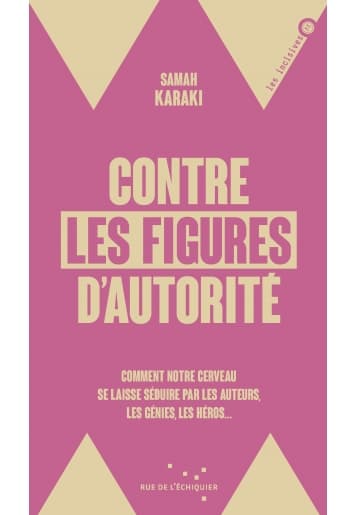
Contre les figures d’autoritéComment notre cerveau se laisse séduire par les auteurs, les génies, les héros, etc.Against Figures of AuthorityHow Our Brains Are Seduced by Authors, Geniuses, and Heroes128 pages. 23rd January 2026. World rights available
Les incisives
NON-FICTION
ESSAY
NEUROSCIENCES
Partant du constat que nous accordons spontanément du crédit au nom posé en haut d’une couverture ou en bas d’un tableau, Samah Karaki analyse comment certaines figures d’autorité constituent une fiction cognitive, un mécanisme mental auquel notre cerveau est spontanément enclin. Il est en effet câblé pour chercher des intentions dans les textes, les images, les musiques.
Mais cette croyance est aussi construite politiquement, puisqu’elle privilégie certains noms et en invisibilise d’autres. Elle fabrique de l’exception, du prestige, du génie individuel au détriment du commun, et nous conduit à adhérer à une certaine organisation symbolique du monde : une hiérarchie qui valorise l’héroïque et l’unique, et marginalise l’anonyme, le collectif ou le mineur.
Au fil de sa réflexion, Samah Karaki nous montre comment notre cerveau, nos institutions et nos récits conjuguent leurs forces pour maintenir vivantes les figures d’autorité. Elle interroge ce que cette fidélité, presque réflexe, produit sur notre culture : quels noms nous retenons, quels autres nous oublions, et quelles formes d’art nous sommes capables ou incapables de reconnaître.
De là, elle nous enjoint à sortir de ces mécanismes et à faire émerger une écologie cognitive de la création et à distribuer autrement notre attention.
Née en 1984 à Beyrouth, Samah Karaki est une neuroscientifique franco-libanaise. Son travail utilise les savoirs des sciences cognitives et humaines pour analyser les enjeux environnementaux et sociaux. Elle est déjà l’autrice de deux essais à succès : Le talent est une fiction (JC Lattès, 2023 ; Le Livre de Poche, 2024) et L’empathie est politique (JC Lattès, 2024).
In her new essay, Samah Karaki starts with the observation that we instinctively grant credibility to the name printed at the top of a book cover or the bottom of a painting. She analyzes how certain figures of authority constitute a cognitive fiction, a mental mechanism to which our brains are spontaneously inclined. Indeed, our brains are wired to seek intentions in texts, images, and music.
Yet this belief is also politically constructed, as it privileges certain names while rendering others invisible. It manufactures exception, prestige, and individual genius at the expense of the common, leading us to adhere to a particular symbolic organization of the world: a hierarchy that valorizes the heroic and the unique, while marginalizing the anonymous, the collective, and the minor.
Throughout her reflection, Karaki demonstrates how our brains, institutions, and narratives combine forces to keep figures of authority alive. She questions what this almost reflexive loyalty produces in our culture: which names we remember, which we forget, and which forms of art we are capable, or incapable, of recognizing.
From this, she urges us to break free from these mechanisms and to foster a cognitive ecology of creation, redistributing our attention in new ways.
Born in Beirut in 1984, Samah Karaki is a French-Lebanese neuroscientist. Her work draws on cognitive and human sciences to analyze environmental and social issues. She is already the author of two bestselling essays: Le talent est une fiction (Talent Is a Fiction, JC Lattès, 2023; Le Livre de Poche, 2024) and L’empathie est politique (Empathy Is Political, JC Lattès, 2024).