Martine Quinio Benamo
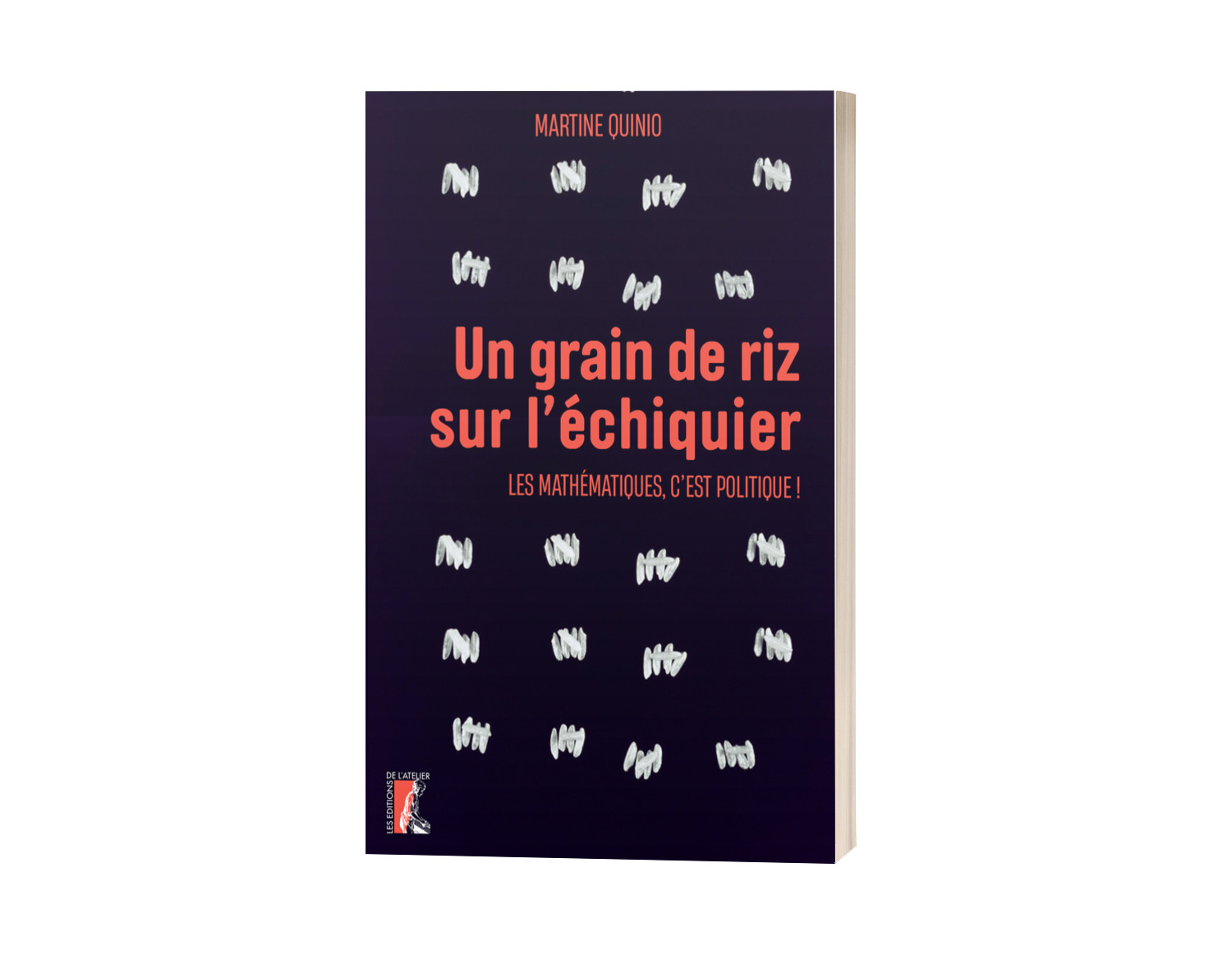
Un grain de riz sur l'échiquierLes mathématiques, c'est politique!A Grain of Rice on the ChessboardMathematics is politics!160 pages. 2023. World rights available
NON-FICTION
POLITICS
SCIENCES
Ce livre, conçu comme une balade à travers les concepts mathématiques, est une invitation à débusquer les facilités dans lesquelles nous tombons trop souvent en matière d’interprétation des chiffres et qui perturbent notre lecture du monde. Du biais de confirmation (cette tendance à sélectionner uniquement les informations qui renforcent nos croyances) au biais des numérateurs (un pourcentage de 0,01 % apparaît comme négligeable alors que 1 cas pour 10 000, mathématiquement identique, va inquiéter), en passant par la confusion entre cause et corrélation et autres pièges… Comment ne pas s’indigner à l’égard du manque de scrupules dans l’utilisation des chiffres à des fins politiques, économiques et sociales ? Et si l’important était d’adopter une attitude mathématique, une voie d’attention à la complexité, à la nuance, au raisonnement pour qualifier avant de quantifier ? Les mathématiques sont un bien commun à partager, pour comprendre ce qui se joue dans le monde et mieux intervenir dans le débat public.
Martine Quinio est professeure agrégée de mathématiques de l’université Aix-Marseille, spécialisée en probabilités. Elle est l’auteure de deux tribunes, l’une dans Le Monde intitulée « La statistique absente des débats » (juin 2020), l’autre dans Libération intitulée « Les mathématiques, c’est politique » (février 2022). Elle est l’auteure de Probabilités et statistique aujourd’hui (L’Harmattan, 2009), coauteure de l'ouvrage Sciences et Humanités, Décloisonner les savoirs pour reconstruire l’université (éditions Presses universitaires de Provence. 2019).
This book, designed as a stroll through mathematical concepts, is an invitation to flush out the easy ways in which we all too often fall into when it comes to interpreting figures, and which disrupt our reading of the world. From confirmation bias (the tendency to select only information that reinforces our beliefs) to numerator bias (a percentage of 0.01% appears negligible whereas 1 in 10,000 cases, mathematically identical, will give cause for concern), not forgetting the confusion between cause and correlation and other pitfalls... How can we fail to be indignant at the lack of scruples in the use of figures for political, economic, and social ends? What if the important thing was to adopt a mathematical attitude, a way of paying attention to complexity, nuance, and reasoning, to qualify before quantifying? Mathematics is a common good that needs to be shared, so that we can understand what's going on in the world and play a greater part in public debate.
Martine Quinio is an associate professor of mathematics at the University of Aix-Marseille, specialising in probability. She is the author of two articles, one in Le Monde entitled "La statistique absente des débats" (June 2020), the other in Libération entitled "Les mathématiques, c'est politique" (February 2022). She is the author of Probabilités et statistique aujourd'hui (L'Harmattan, 2009) and co-author of Sciences et Humanités, Décloisonner les savoirs pour reconstruire l'université (Presses universitaires de Provence, 2019).
"A book rich in examples, [which] shows how this discipline can enable us to understand current developments and to reason correctly in order to conduct a high-quality democratic debate.
Paul Mazliak, l'HUMANITE
"Fluidly written, this book examines a number of topical issues using a mathematical approach".
Antoine Rolland, TANGENTE
"Mathematics can help us to be more far-sighted than we are".
Frédéric Taddeï, EUROPE 1
"This book, conceived as a stroll through mathematical concepts, is an invitation to flush out the easy ways in which we too often fall into when it comes to interpreting numbers, and which disrupt our reading of the world. A social vision of mathematics".
FLORILEGE MATHS